
Asset Tracking & Management: The Intelligence Layer

In today’s digital-first world, understanding how your assets are utilized and perform is no longer optional—it’s essential. Asset analytics tools have been around for years, but artificial intelligence (AI) is redefining how we approach and optimize asset performance
In today’s digital-first world, understanding how your assets are utilized and perform is no longer optional—it’s essential. Asset analytics tools have been around for years, but artificial intelligence (AI) is redefining how we approach and optimize asset performance
Every enterprise tracks assets. But few truly manage them. There is a fundamental gap between knowing that an asset exists and knowing where it is right now, what it's worth today, who is responsible for it, and whether it's being used — or quietly walking out the door.
Asset Intelligence closes that gap.
What Is Asset Intelligence?
Asset Intelligence enhances asset tracking by linking operations, business intelligence, and process workflows. This integration increases traceability, optimizes utilization, and reduces loss and waste throughout your business.
Put simply:
Asset Tracking + Operational Intelligence = Asset Intelligence
Asset Intelligence is the result of integrating operational processes with established asset rules and notification systems. By connecting these rules, users receive automatic notifications when actual outcomes differ from expectations. Exceptions are identified through continuous monitoring of both assets and their related processes — not after the fact, but in real time.
The Real Challenges Behind Asset Management
Before exploring the solution, it's worth being honest about the challenges. They are significant, and they affect nearly every enterprise.
1. Procurement is unstructured by default.Asset management begins at enterprise procurement — and that process is often unstructured and lacks proper tracking. Users request assets with vendor-specific details, while finance creates purchase orders using broad asset descriptions linked to classes and sub-classes. These systems were never designed for item-level asset monitoring.
2. Legacy data is a black box.Many organizations struggle to track assets acquired years ago. Retrieving asset details from legacy purchasing systems and past ad hoc processes is a genuine operational challenge — not just a data problem.
3. Part number categorization is harder than it looks.Customers often struggle to effectively categorize assets that share similarities by their part numbers, and assigning distinctive tracking numbers to each item proves difficult when extracting information from old purchase orders.
4. IT services firms face a uniquely complex landscape.For IT services firms, asset tracking spans multiple enterprises. These companies manage assets for multinational clients through Global Capability Centers (GCC) and Offshore Development Centers (ODC), requiring complete traceability of both client and company-owned assets. Tracking by business owner and custodian is not optional — it is essential.
Asset Intelligence solutions must embrace these challenges and provide customers with an effective and efficient way to migrate their past purchases, integrate their existing purchasing processes, and build a complete asset tracking and management system.
How Asset Intelligence Works: From Day One to Full Automation
Getting started is straightforward. If item-level data already exists, it can be exported to the Asset Intelligence platform via CSV or open REST APIs. The platform automatically creates unique EPC Global Item Asset Identifier (GIAI) serial numbers, which are used for RFID and barcode labels.
When item-level data isn't available, a structured onboarding process builds the foundation:
- Export past purchase order data
- Integrate the asset procurement process with Asset Intelligence
- Integrate receiving processes with Asset Intelligence to track assets from day one
- Create a process to attach RFID/barcode labels to trackable assets
- Establish stock-take processes by location using mobile scanners
- Optionally, integrate fixed RFID readers to fully automate asset tracking
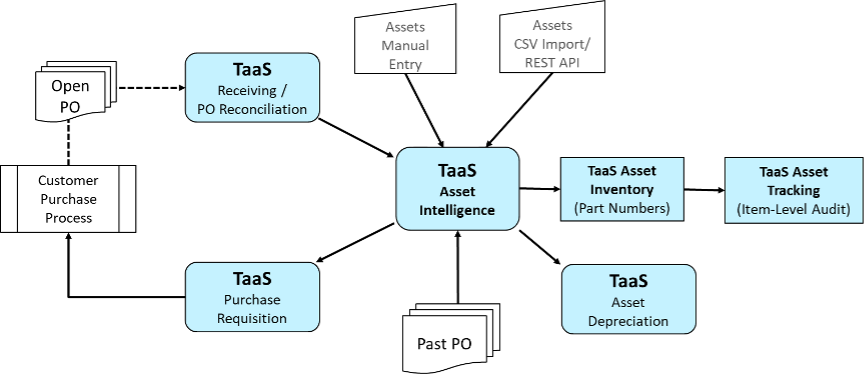
Once past purchase data, current purchasing, and receiving processes are integrated, the baseline for complete asset management is in place. Asset Intelligence provides the RFID/barcode labels and the procedure to commission assets with globally unique GIAI identifiers.
Asset Tracking RFID: Scalable, Cost-Effective, and Built for the Real World
RFID is a cost-effective, low-maintenance, and scalable solution for tracking assets with inexpensive passive tags. Asset Intelligence delivers quick ROI — handheld readers scan tags by location without requiring fixed readers or installation costs.
For organizations ready for full automation, Asset Intelligence offers easy deployment of fixed RFID readers as portals, RTLS anchors, and auto-inventory zones. The solutions are compatible with a wide range of top RFID readers and tags, giving customers the flexibility to choose mobile or fixed readers to handle stock-taking, monitoring, and tracking in their operations.
Fixed RFID read zones automatically record entry and exit times, updating asset locations without manual checks. This automated tracking helps reduce losses. Clear rules can trigger alerts for unauthorized movements or missed checkpoints.
Mobile RFID handheld devices and stock-take workflows help track assets and provide alerts for missing, misplaced, or underutilized items.
Real-Time Location Services (RTLS) accurately assign locations to assets, even when multiple RFID readers detect the same item simultaneously.
Asset Tracking Barcode: The Entry Point for Any Operation
For teams that are not yet ready for RFID, barcode-based asset tracking is a proven starting point. Asset Intelligence supports barcode labels alongside RFID, giving operations teams a practical on-ramp into systematic asset management — with a clear path to upgrading when the time is right.
Location Management: From Building to Shelf
Asset Intelligence provides geo-location tracking services that monitor assets from the building level all the way down to specific shelves. By mapping locations within buildings, users can set up rules to track asset movement and usage, ensuring a complete operational audit trail throughout each asset's lifecycle.
RFID read zones can be linked to locations for automated tracking, and mobile scanners can also track assets by location.
GCC Tracking: Managing Assets Across Multiple Enterprises
For IT services companies operating Global Capability Centers and Offshore Development Centers, asset management is an inherently multi-layered challenge. Assets belong to different business owners — client-owned versus company-owned — and must be managed across geographies with full traceability.
Asset Intelligence is purpose-built to support this model. Assets can be managed and tracked by business owner and/or GCC/ODC operation, with complete audit trails for every movement, assignment, and status change.
Asset Depreciation and Financial Compliance
Asset Intelligence can be used to manage depreciation with asset tracking for audit compliance. Users can view reports of asset value at the item level or by class, vendor, attribute, location, and more — making it straightforward to maintain audit-ready depreciation and financial compliance reports.

Business Benefits at a Glance
Asset Intelligence streamlines asset management and tracking while enhancing operations from procurement to deployment. Delivered as a secure private-cloud SaaS, it removes IT and deployment challenges.
- Stop losing equipment
- Eliminate duplicate and over-purchasing of assets
- Achieve ROI in less than one month
- Reconcile each purchased asset and track assets from the get-go
- Complete asset movement and operational audit trails
- Know where every asset is, what it's worth, and when it needs attention — automatically
- Audit-ready depreciation and financial compliance reports
- Over 30× improvement in manual stock-take efficiency
- Mature requisition and receiving processes with automated purchase reconciliation
- Manage and track assets by business owner and/or GCC/ODC operation
- SaaS-based solution that eliminates IT and deployment complexity
About TaaS-AI Asset Intelligence
TaaS-AI Asset Intelligence offers comprehensive asset tracking and management. Developed by OmniTaaS with top industry partners, its Premise-on-CloudTM architecture helps customers streamline operations, boost asset efficiency, improve utilization, and minimize losses.
Ready to see what Asset Intelligence can do for your operations?


Written By