
Manufacturing Intelligence: The Future of Smart Production
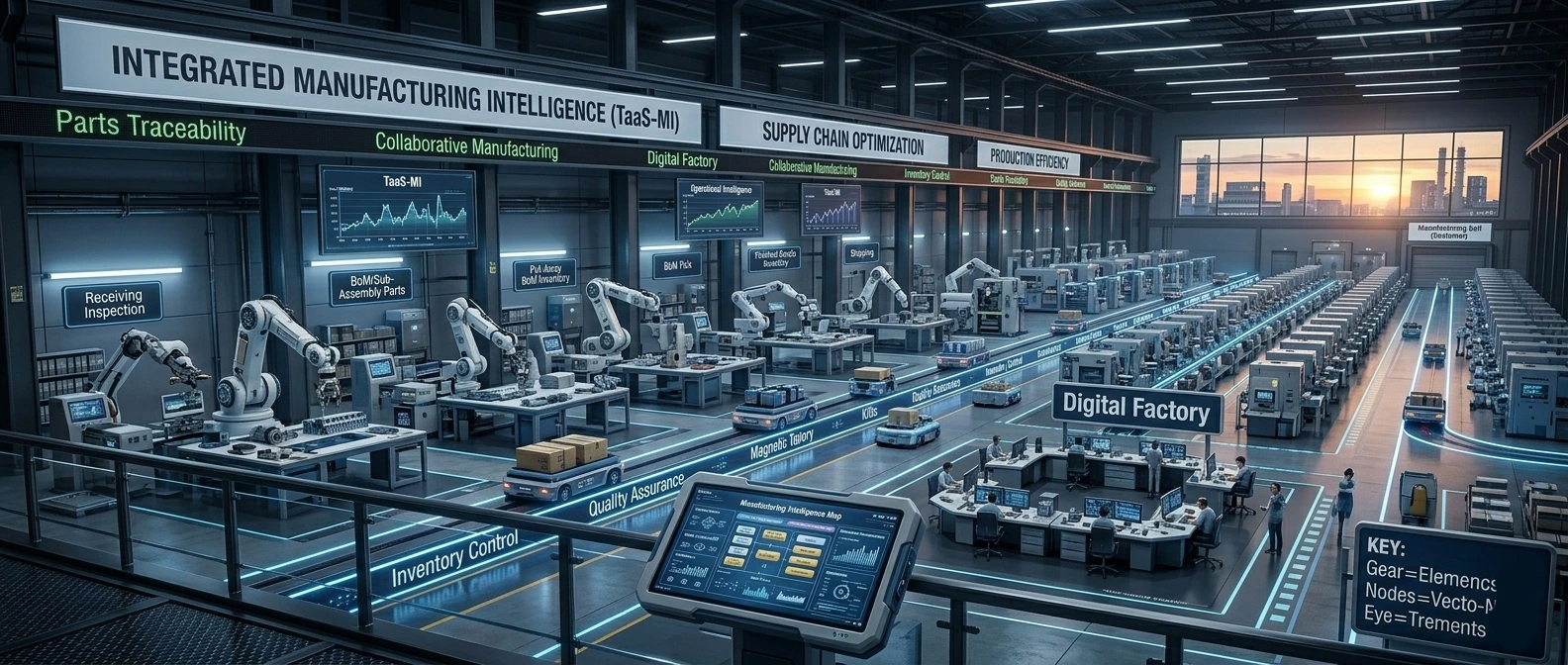
In today’s digital-first world, understanding how your assets are utilized and perform is no longer optional—it’s essential. Asset analytics tools have been around for years, but artificial intelligence (AI) is redefining how we approach and optimize asset performance
*In an era where a single delayed shipment can ripple across continents and a defective component can quietly work its way into thousands of finished products, manufacturers can no longer afford to operate on instinct and spreadsheets. The factory floor has grown too complex, too interconnected, and too consequential for anything less than real-time intelligence. Yet for many operations, critical decisions are still made with incomplete data, delayed reports, and a persistent blind spot between what's happening on the shop floor and what leadership actually sees. Manufacturing Intelligence was built to close that gap — turning fragmented operational data into a unified, predictive, and collaborative force that keeps production moving and customers informed.*
What is Manufacturing Intelligence?
Manufacturing has long passed being a localized single-plant operation. Apart from being the heartbeat of human innovation, it has become the pulse that binds our world into an economically interdependent global village.
Manufacturing Intelligence increases production delivery by linking information through work order tracking, collaborative manufacturing, raw material traceability, and operational transparency with suppliers. This digital integration optimizes on-time delivery, reduces waste, and increases throughput in your production process.
Manufacturing Intelligence (MI) results from linking AI with operational processes to optimize resources and tasks with accurate delivery commitments — and automating actionable alerts by predicting outcomes that differ from expectations, impacting quality and on-time delivery. Exceptions are identified through intelligent monitoring of both work orders and their related processes. Furthermore, MI extends supplier management to collaborative manufacturing, enabling further transparency through shopfloor-to-shopfloor connectivity between operating partners.
Put simply:
**Work Order Tracking + Operational Intelligence + Collaborative Manufacturing = Manufacturing Intelligence**
The Challenges in Modern Manufacturing
Manufacturing begins with the procurement of required raw materials, which are often unstructured and lack supplier transparency for proper tracking. Production estimates vendor-specific bill of materials (BoM) based on sales orders and forecasts. However, timing from purchase order to receipt can sometimes be highly variable and reactive, based on supplier and transport logistics.
Manufacturers organize assembly tasks in manufacturing cells to deliver multiple, but similar, products. Production lines share the same resources and overlap Bills of Materials (BoM). Defects or delivery issues with raw materials required by a task — or quality issues on one production line — can impact delivery on other production lines sharing the same resources.
Additionally, defects found on a specific lot of raw material or sub-assembly parts can result in multiple products, across production lines, integrating the defective part. Operators may also impact on-time delivery due to time spent repairing defective supplier parts or dependent sub-assemblies. Complex supply chains compounded by lack of supplier transparency can even result in receiving fraudulent parts.
Inability to accurately forecast delivery schedules — based on available raw materials, WIP inventory, open purchase orders, and production saturation — can result in lost sales due to over-estimating delivery commitments.
Last but not least: the inability to proactively monitor and act on exceptions in real-time, before they impact quality and, most importantly, on-time delivery.
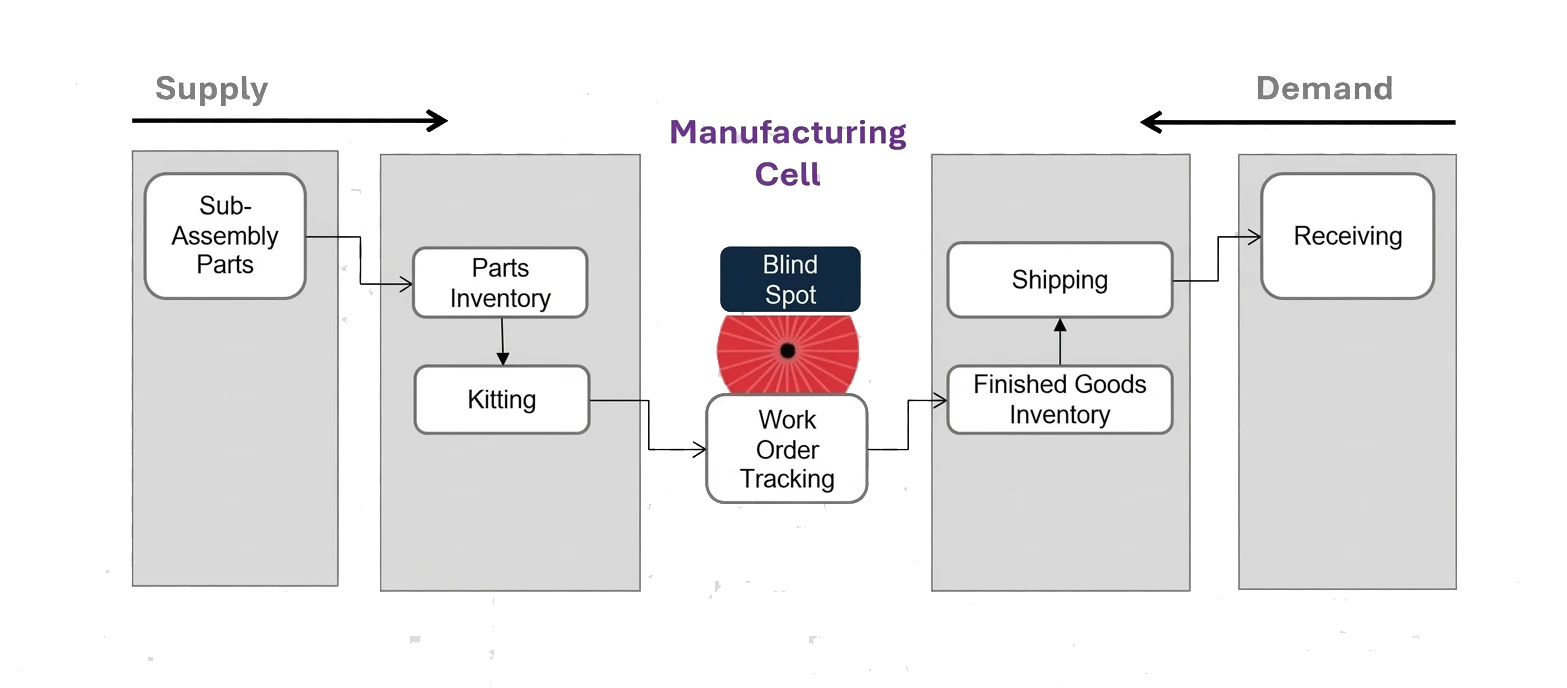
The "Manufacturing Blindspot"
On-time delivery is often the top concern for manufacturing. Tracking the cause, timing, and location of delayed work orders is a constant priority. Moreover, correlating exceptions impacting customers and quality becomes reactive, creating continuous crisis management. Simply tracking work orders does not solve this problem.
To eliminate blind spots and attain genuine operational intelligence, manufacturing operations must integrate historical and real-time data from all relevant processes. By doing so, exceptions can be addressed proactively, minimizing their impact on timely delivery.
Common blindspots include:
- Lack of raw material inventory available and allocated by product
- Lack of real-time production status by product and customer
- Lack of end-to-end visibility from sub-assemblies through final product
- Lack of supplier transparency on potential delivery exceptions
- Lack of exception monitoring on bottlenecks, rework, and work time by task
- Lack of actionable insights impacting on-time delivery when experiencing exceptions
- Lack of real-time data for daily operating reports and customer status updates
- Lack of raw material pedigree to effectively recall and replace defective parts
- Lack of available and committed WIP inventory by part and customer
- Lack of item-level operational and component parts traceability
- Lack of data to accurately forecast delivery dates for new orders
Manufacturing Traceability
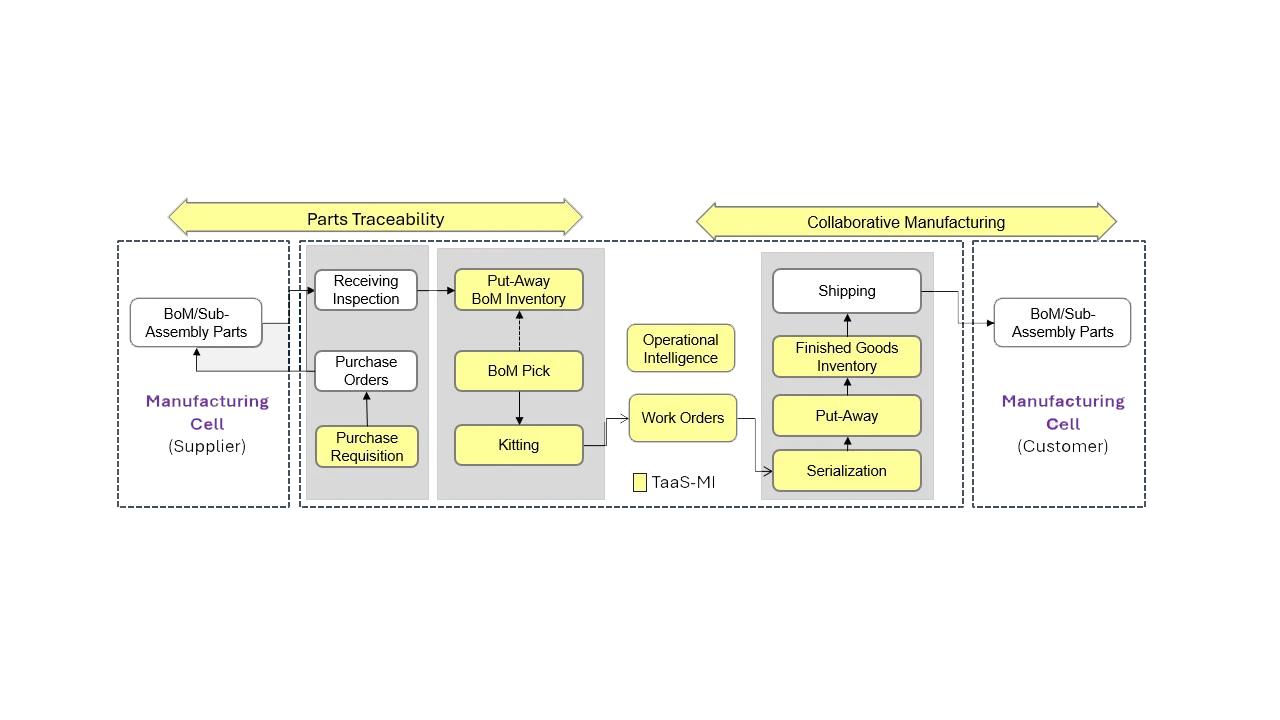
MI tracks order procurement and reconciles purchase orders during the receiving process to provide timing on key parts — enabling more accurate planning and forecasting schedules. Integrating put-away processes further increases efficiency in executing pick lists for materials required to fulfill orders.
Managing and tracking pick and kitting processes reduces miss-picks and improves raw material traceability. Tracking procure-to-kitting time helps sales and production make accurate order commitments. Operations can also quickly alert and replace defective parts in affected work orders before they are used.
MI links all operational exceptions and quality metrics directly to each manufactured item. Traceability includes tracking both the origin of parts and the operational steps completed during the manufacturing process.
Manufacturing Digital Twin
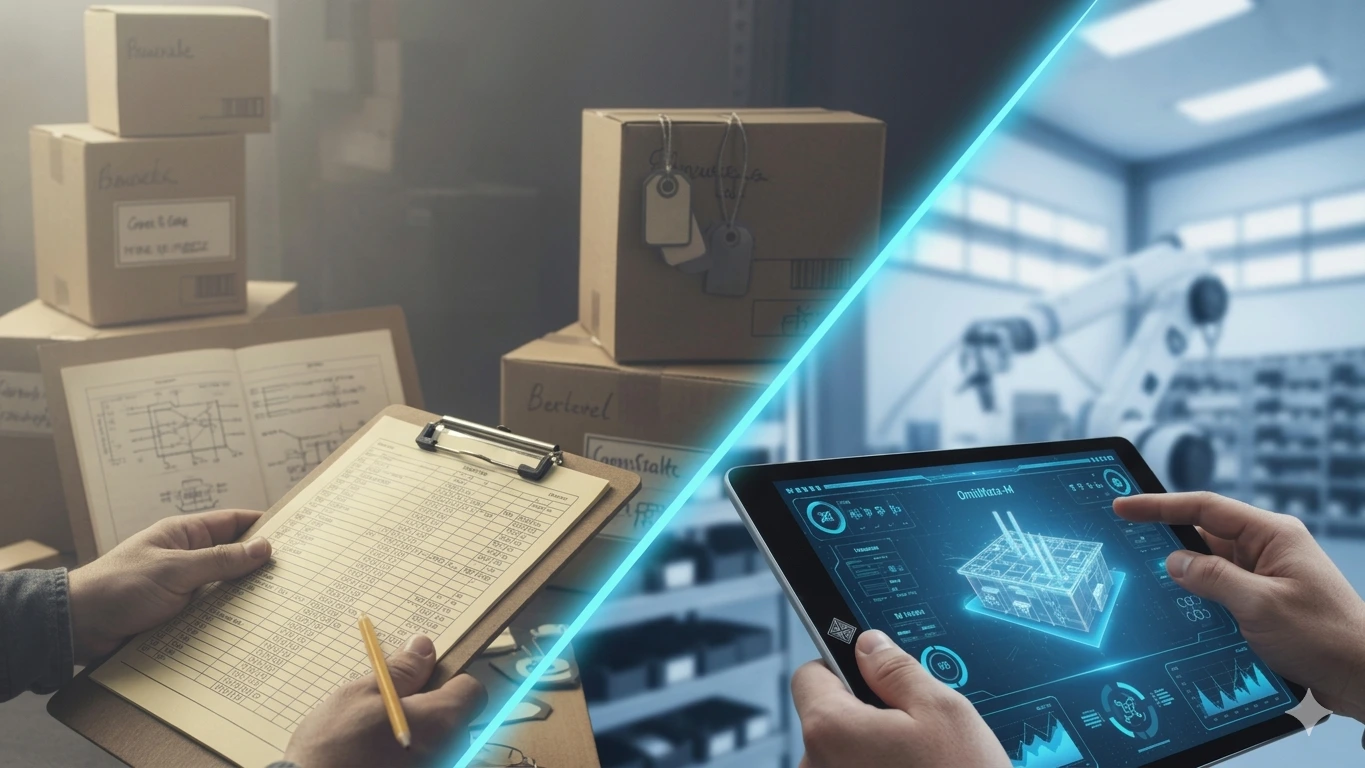
MI extends work order tracking into a comprehensive and visual operational digital twin — automatically capturing bill of materials pedigree, including an operational audit for each item manufactured. MI applies automated predictive analytics on work order tracking to provide real-time actionable insights the moment a deviation from the expected plan is detected.
MI Digital Twins provide a digital view of each product line by manufacturing cell, delivering:
- **Real-time operational visibility** (What, Who, When, Where, Why) on job orders with predictive exception notifications
- **99% on-time delivery (OTD)** target achievement
- **Automated daily operating reports** and customer status reports
- **Improved shop floor to top floor collaboration**
- Detection of deviations that would impact OTD before they escalate
- Tracking of saturation and bottleneck fixes before they occur
- Monitoring and alerts on irregular worktime, idle, and wait times by work order
- Increased and optimized resource utilization, by stage and technician
- Measurement of every process stage by product line
- Performance metrics and analytics by manufacturing cell (across all product lines)
- Financial views of costs by stage, product line, and sales order
Work Order Tracking with RFID: Scalable, Cost-Effective, and Built for the Real World
RFID is a cost-effective, low-maintenance, and scalable solution for tracking assets with inexpensive passive tags. Manufacturing Intelligence delivers quick ROI — handheld readers scan tags by stage without requiring fixed readers or installation costs.
For organizations ready for full automation, MI offers easy deployment of fixed RFID readers as portals, RTLS anchors, and auto-inventory zones. The solutions are compatible with a wide range of top RFID readers and tags, giving customers the flexibility to choose mobile or fixed readers to automate monitoring and tracking in their operations.
Fixed RFID read zones automatically record entry and exit times, updating work times and on-time delivery forecasts without manual checks. This automated tracking allows management to focus where it matters most — reducing late deliveries and improving quality. Integrated AI enables MI to create rules and trigger alerts on where and when attention is needed.
**Real-Time Location Services (RTLS)** accurately assign locations to work orders, even when multiple RFID readers detect the same order simultaneously.
Work Order Tracking with Barcode: The Entry Point for Any Operation
For teams that are not yet ready for RFID, barcode-based work order tracking is a proven starting point. Asset Intelligence supports barcode travelers alongside RFID tracking, giving operations teams a practical on-ramp into automated order management — with a clear path to upgrading when the time is right.
MI will also automatically serialize each manufactured part with EPC-compliant, globally unique identifiers. If required, unique serial identifiers can be affixed to finished goods using RFID or 2D barcode labels. Although MI provides traceability by part and lot numbers, uniquely serialized items eliminate fraud and loss through shipping and transport logistics.
Collaborative Manufacturing
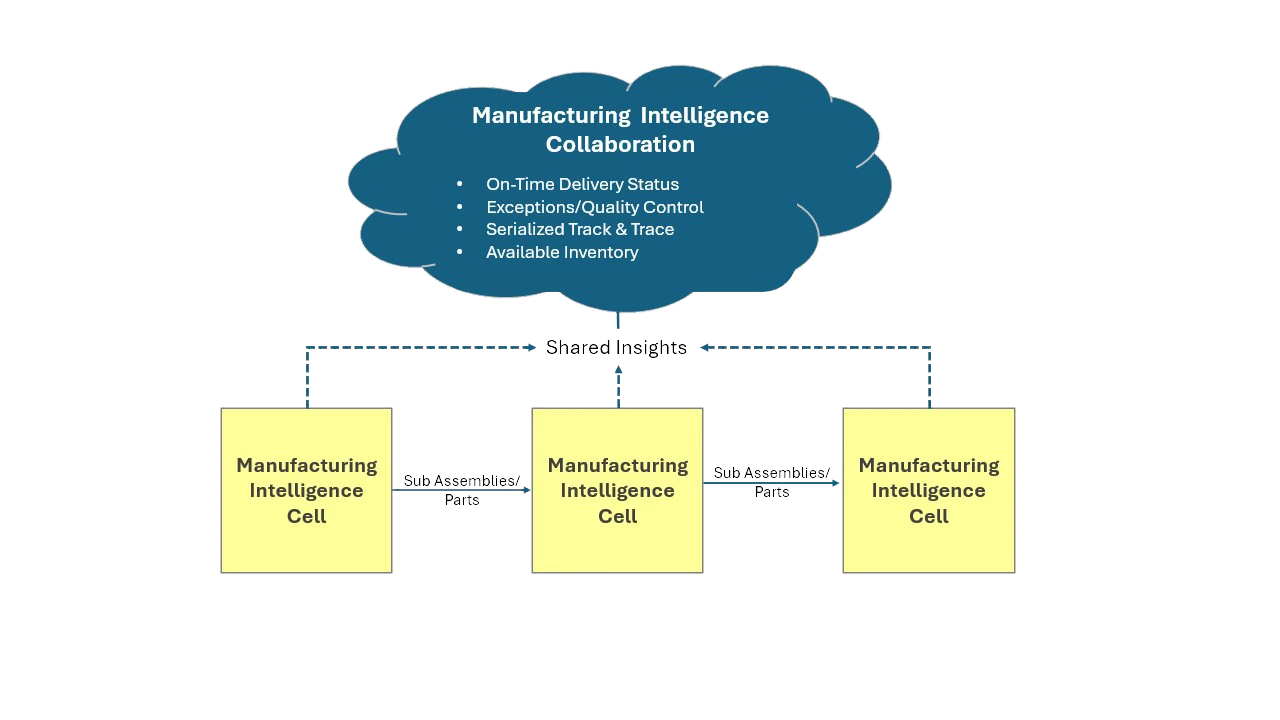
Manufacturing Intelligence not only increases operational efficiency — it can automatically publish controlled status updates for customer and top-floor consumption. No more chasing the ever-elusive question: *"Where's my stuff?"*
MI transforms supplier management into high-integrity Manufacturing Collaboration. Operations can collaborate without status meetings on a shared, common view of order status and completion projections.
An integrated collaborative environment:
- Achieves the gold standard for customer trust and allocations on ordered parts
- Removes the headaches of status reports that require ongoing manual collection and correlation of shop-floor data with customer orders
- Allows business operations, sales, and management to easily track orders and manage customers without contacting shop-floor operations
- Eliminates supply chain and logistics issues related to fraud, tracking, and loss
About TaaS-MI
**TaaS Manufacturing Intelligence** offers a comprehensive work order tracking, traceability, and controlled collaborative manufacturing environment. Developed by **Omnitaas** with top industry partners, its *premise-on-cloud®* architecture helps customers streamline operations, boost operational efficiency, increase revenues, and minimize losses.
© 2026 Omnitaas / TaaS-MI. All rights reserved.

Written By